
Car, Truck, or Semi: Which Type of Tow Truck Do You Need?
If your car won’t start or you’re just planning ahead, you may have heard that the wrong tow truck can damage a vehicle. This is especially true for all-wheel drive and four-wheel drive vehicles. You want a straight answer for your own vehicle, not a full list of every tow truck ever made.
There are four main types of tow trucks: flatbed, wheel lift, hook and chain, and heavy duty. Which one is right for you depends mainly on what you’re driving, a car, a truck, or a semi, and how that vehicle is built, not just its size.
This guide walks through each type and each vehicle category so you know what to expect and what to ask for.
Table of Contents
ToggleThe Main Types of Tow Trucks
Before getting into which vehicle needs what, here is a quick look at how each type of tow truck actually works.
Flatbed Tow Trucks
- A flatbed tow truck carries a vehicle fully off the ground on a flat, tilting platform, rather than pulling it on its own wheels.
- Loads the whole vehicle onto a flat platform that tilts down to the ground, so all four wheels come off the road.
- Used for daily driver cars, SUVs, vans, classic and luxury cars, any AWD or 4WD vehicle, long-distance tows, and vehicles that can’t be driven after an accident.
- The safest and most flexible option, since nothing touches the ground and there’s no strain on the drivetrain.
- Usually costs more to hook up and needs more room to load than a wheel lift.
Wheel-Lift Tow Trucks
- A wheel-lift tow truck lifts two of a vehicle’s wheels off the ground with a hydraulic arm, while the other two wheels roll along the road.
- Uses a hydraulic arm and a metal yoke to lift either the front or rear wheels, while the other two stay on the road.
- Built for quick, local tows of standard two-wheel-drive vehicles, like moving a car from a lot to a nearby shop.
- Fast to hook up and usually cheaper than a flatbed for short trips.
- Not safe for AWD or 4WD vehicles, since two wheels keep turning while towed, and it wears tires and bearings faster over distance.
Hook and Chain Tow Trucks
- A hook and chain tow truck is an older style of tow truck that hooks directly onto a vehicle’s frame or axle to pull it.
- Attaches a chain directly to the vehicle’s frame or axle, then lifts that end with the truck’s boom.
- Mostly reserved today for totaled, scrap, or junk vehicles headed to salvage.
- Simple, low-cost equipment that still works for scrap and junk removal.
- Puts direct pressure on the frame and can damage bumpers and undercarriage parts on modern vehicles, which is why most companies have phased it out.
Heavy-Duty and Integrated Tow Trucks
- A heavy-duty or integrated tow truck is a larger, more powerful tow truck built to handle vehicles far heavier than a standard car or SUV.
- Built on a bigger frame with a stronger winch, using a flatbed, wheel lift, or boom setup rated for much higher weight.
- Handles box trucks, buses, RVs, larger pickups, and other commercial vehicles too heavy for standard equipment.
- Rated for much higher weight than standard trucks, so it can tow or recover vehicles smaller trucks can’t handle.
- Costs more to send out and isn’t necessary for a standard passenger car.
Rotator Tow Trucks
- A rotator tow truck is a heavy-duty tow truck with a rotating crane arm, built for the most difficult recovery and towing jobs.
- Uses a rotating crane arm that reaches angles a straight boom can’t.
- Used for semi trucks, rollovers, jackknifed trailers, and vehicles stuck off-road or in a ditch.
- Handles the toughest recovery jobs and the heaviest commercial vehicles.
- The most expensive and least common option, usually billed by the hour instead of a flat rate.
Weight Capacity Comparison
These are typical industry ranges, not exact specs for one specific truck. Capacity varies by the make and model of the tow truck itself.
| Tow truck type | Typical weight capacity | Best fit |
| Flatbed (light-duty) | Up to about 5,000 lbs | Cars, SUVs, vans, AWD/4WD vehicles |
| Wheel-lift | Up to about 7,000 lbs | Standard 2WD cars, short local tows |
| Hook and chain | Up to about 5,000 lbs | Scrap or totaled vehicles only |
| Heavy-duty / integrated | Up to about 50,000 lbs | Box trucks, buses, RVs, heavy pickups |
| Rotator | About 75,000 lbs and up | Semi trucks, rollovers, off-road recovery |
Typical Cost Estimates
| Service type | Typical hookup fee | Typical per-mile rate |
| Wheel-lift / standard towing | $50 to $85 | $3 to $5 per mile |
| Flatbed towing | $75 to $125 | $4 to $7 per mile |
| Heavy-duty / semi towing | $250 to $600 | $4 to $15 per mile (rotator recovery is often billed hourly instead) |
How to Choose the Right Type of Tow Truck for Your Situation
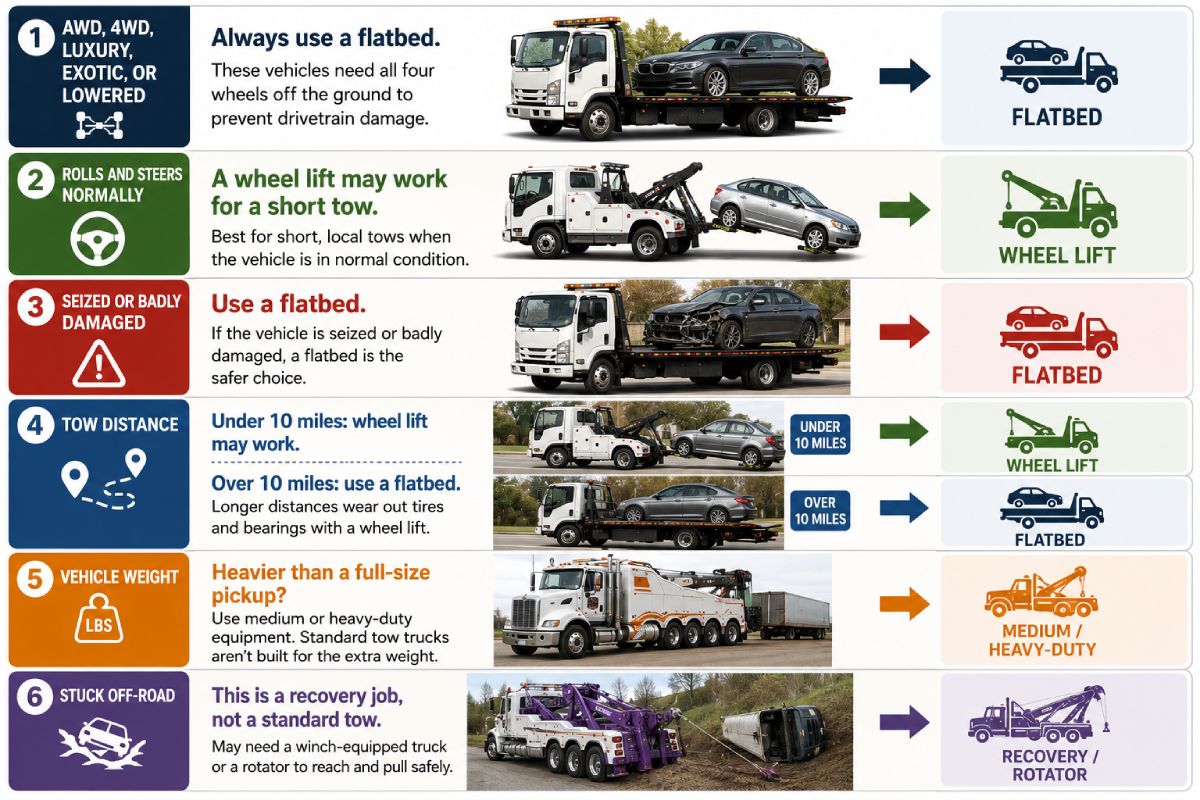
You don’t need to memorize every truck design or tow truck type. A few simple facts about your vehicle and situation point to the right equipment.
If You’re Towing a Car
A flatbed is the only safe choice for an AWD or 4WD car, since all four wheels stay off the ground. A wheel lift works fine for a standard front-wheel or rear-wheel-drive car on a short, local tow, but a longer trip is better on a flatbed. A car that won’t roll or steer, or is stuck somewhere tight like a ditch or a garage, also needs a flatbed regardless of drivetrain. Hook and chain trucks are outdated and reserved for totaled or scrap cars. A light and medium-duty towing team handles cars, SUVs, and vans of every size.
If You’re Towing a Truck or SUV
A heavy-duty tow truck is the right call once a vehicle exceeds what a standard flatbed or wheel-lift can handle, common with larger trucks and SUVs. The same AWD/4WD caution applies here, often more so. A long tow or a vehicle stuck off-road also needs the extra capacity a heavy-duty truck brings. A heavy duty towing service is built for exactly this kind of vehicle.
If You’re Towing a Semi Truck or Trailer
An integrated or rotator truck is the right choice for a semi or large trailer, since standard equipment isn’t built for commercial weight and length. A rollover, jackknife, or off-road recovery needs heavy-duty recovery equipment instead of a standard tow, and an oversized load or disabled equipment that can’t be driven on needs heavy hauling on a lowboy trailer. A long haul adds real time and cost with equipment this size. A semi truck towing, heavy duty recovery, and heavy hauling teams cover every one of these situations.
Note: Telling dispatch these details when you call helps them send the right truck the first time.
Does the Wrong Tow Truck Damage Your Car?
Towing an all-wheel drive or four-wheel drive vehicle with any wheels still touching the ground can strain the transmission or drivetrain. These systems aren’t built to have only some wheels turning while the vehicle is being towed. A flatbed avoids this risk completely, since no wheels touch the ground at all.
This is a real risk for AWD and 4WD vehicles specifically. It doesn’t mean every non-flatbed tow causes damage to every vehicle. A good dispatcher should ask what kind of drivetrain your vehicle has before sending a truck, and it’s worth mentioning it yourself if they don’t ask.
The Right Tow Truck for Your Need in North Las Vegas
Knowing the type of tow trucks and whether your vehicle is AWD or 4WD, roughly how big it is, and whether it’s a normal breakdown or an accident helps dispatch send the right truck on the first try, instead of guessing.
All State Towing LLC sends the right equipment for the job across North Las Vegas and the surrounding area: a flatbed for a car, a heavy-duty truck for a larger vehicle, or a rotator for a semi. If you’re not sure what you need, just call and describe your vehicle, and we’ll match the right truck to it.
- Visit us at 3365 W Craig Rd, North Las Vegas, NV 89032.
- Call us at 702-635-4052.
FAQs
What is the most common type of tow truck?
Flatbed and wheel-lift are the two most common for everyday cars. Flatbed is increasingly the default, since it’s safe for the widest range of vehicles.
Can any tow truck tow an all-wheel-drive vehicle?
Not safely. Only a flatbed keeps all four wheels off the ground, which is what an AWD vehicle needs.
Why don’t tow companies use hook and chain trucks anymore?
It attaches directly to the frame or axle, which can damage modern vehicles. Most companies now save it for scrap or totaled cars only.
What type of tow truck do I need for a motorcycle?
A flatbed, secured with wheel chocks and tie-downs. A standard car wheel-lift isn’t built to carry a motorcycle safely.
What kind of tow truck is used for semi-trucks?
An integrated or rotator truck, built for commercial weight and length. A rollover or off-road recovery needs heavy-duty recovery equipment instead.
Does towing an AWD car damage it?
It can, if any wheels stay on the ground, since the drivetrain isn’t built for that. A flatbed avoids this by keeping all four wheels up.
How can you tell if your vehicle needs a flatbed tow truck or a regular tow truck?
AWD or 4WD means flatbed, always. A standard front-wheel or rear-wheel-drive car is usually fine on a wheel-lift for a short distance.
Can you tow an AWD car on a dolly?
No, not safely. A dolly still leaves the rear wheels turning, carrying the same risk as a wheel-lift tow.
What kind of tow truck do I need for a truck or SUV?
A heavy-duty flatbed or wheel-lift rated for the extra weight. If it’s also AWD or 4WD, flatbed is the call.
What kind of tow truck is used for a semi truck?
An integrated or rotator truck built for commercial weight and length. A rollover or off-road recovery needs heavy-duty recovery equipment instead.